The Digital Athlete | Part 3 | 4 min read
What Should You Train in Basketball? How to Build Skills Around Your Playing Style
A practical guide to choosing basketball skills that match your playing style, strengthen your identity and fix the weaknesses that actually limit your game.
A practical guide for developing players deciding which skills to prioritize in individual workouts, when to attack weaknesses and how to make training translate to real games.
Cover image: AI-generated using ChatGPT for illustrative purposes.
Growing up, I admired the way great scorers played. I was not old enough to watch Michael Jordan's career live, so I discovered much of his game through documentaries and old footage. I did the same with Kobe Bryant, studying the footwork, pull-ups and confidence. Today, I enjoy watching players such as Shai Gilgeous-Alexander and Anthony Edwards.
But admiring a player's game does not mean their game should become mine.
My own basketball style is built around explosiveness, athleticism and changes of pace. Trying to copy every move I see would not automatically make me a better player. The better question is: What skills actually make my game more effective?
That is where smarter basketball training begins.
Train Your Game, Not Your Favourite Player's Game
Every basketball player needs fundamentals, but not every player needs to spend the same amount of time on every skill.
USA Basketball's Player Development Curriculum uses a progressive model that develops fundamental skills before increasing the complexity and competitiveness of training. The foundation matters.
The mistake is thinking your workout must look like your favourite NBA player's workout.
If I spent most of my training time learning difficult isolation combinations simply because I enjoy watching them, I could neglect skills that appear more often in my own game. For me, improving my first step, change of pace, finishing, shooting consistency and decision-making may create more value.
The goal is not to copy a player. It is to borrow useful tools.
Start by Identifying Your Basketball Playing Style
To understand how to train for your basketball playing style, begin by looking at what actually happens when you play.
Ask yourself:
- How do I usually create an advantage?
- Where do most of my shots come from?
- What does my team rely on me to do?
- Which situations make me uncomfortable?
- What skill would make my current strengths harder to defend?
Research supports the idea that basketball demands are not identical for every player. A 2025 systematic review of professional and semiprofessional players found meaningful positional differences in accelerations, decelerations, high-speed running and technical actions.
Position alone does not define your identity, but the finding reinforces an important idea: different players face different demands.
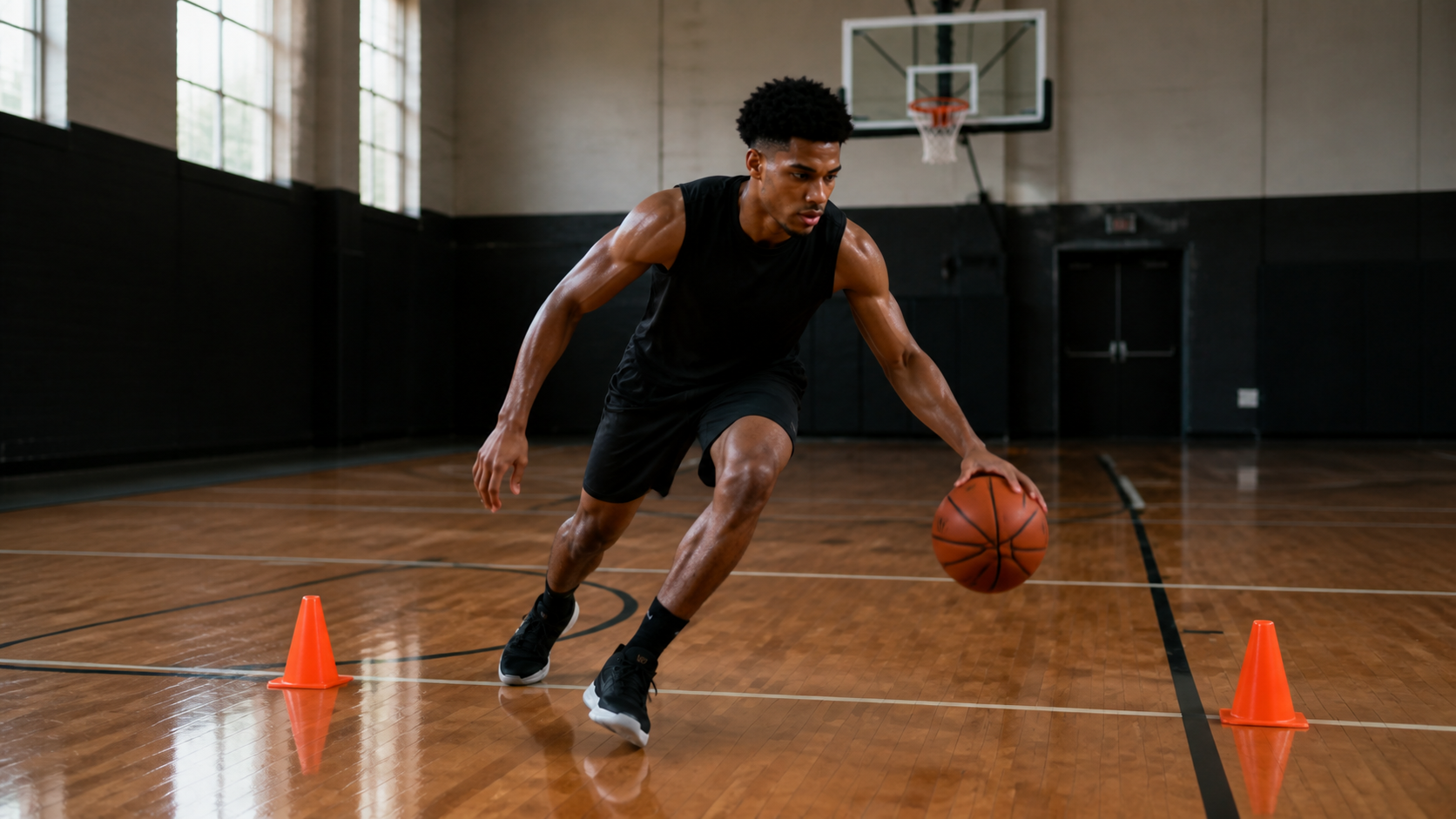
Image credit: AI-generated using ChatGPT for illustrative purposes.
Build Your Training Around Three Priorities
When deciding which basketball skills to work on, I think about three categories.
1. Fundamentals
These are skills every player needs: ball control, passing, shooting basics, finishing, defence and decision-making. Your playing style should never become an excuse to ignore them.
2. Identity Skills
These are the abilities that make your game effective.
For an explosive player like me, that could mean attacking closeouts, changing pace, finishing through different angles and controlling my body after quick acceleration.
For another player, it might be shooting, post play, pick-and-roll creation or defence.
3. Limiting Weaknesses
A weakness deserves extra attention when it stops your strengths from working.
If you can beat defenders with your first step but cannot finish with your weak hand, that weakness limits your advantage. If you are a strong shooter but cannot attack a closeout, defenders can take away your best weapon.
Training should strengthen your identity and remove the weaknesses holding it back.
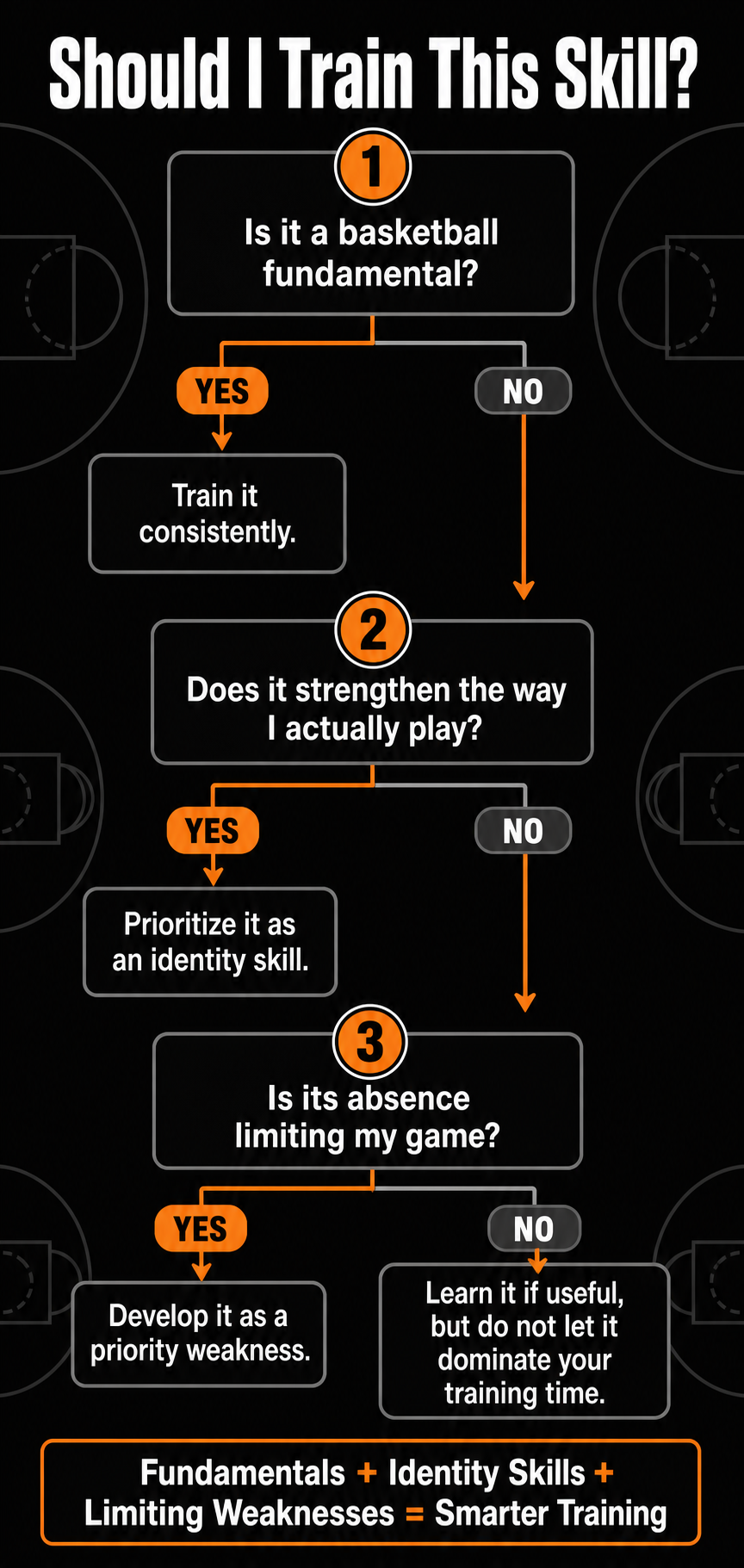
Infographic: AI-generated using ChatGPT from an original concept by Eformeh Wisdom.
Your Workout Should Have a Reason
Individualized training can matter. A 2026 basketball agility study found both position-dependent responses and substantial individual variation, supporting the value of adapting training instead of assuming every athlete responds the same way.
This follows the same principle I explored in Stop Guessing. Start Tracking.: use evidence from your actual game to make better training decisions.
Before adding a new drill to your workout, ask:
Is this a fundamental? Does it strengthen my playing style? Or is it fixing something that limits me?
If the answer is no to all three, the skill may still be useful, but it probably should not dominate your training time.
Your favourite player can inspire your game without defining it.
Study great players. Borrow what fits. Then build a game that is actually yours.